What Does ₹5 Lakh in Influencer Marketing Actually Buy You in 2026?
The AI Summary (TL;DR)
-
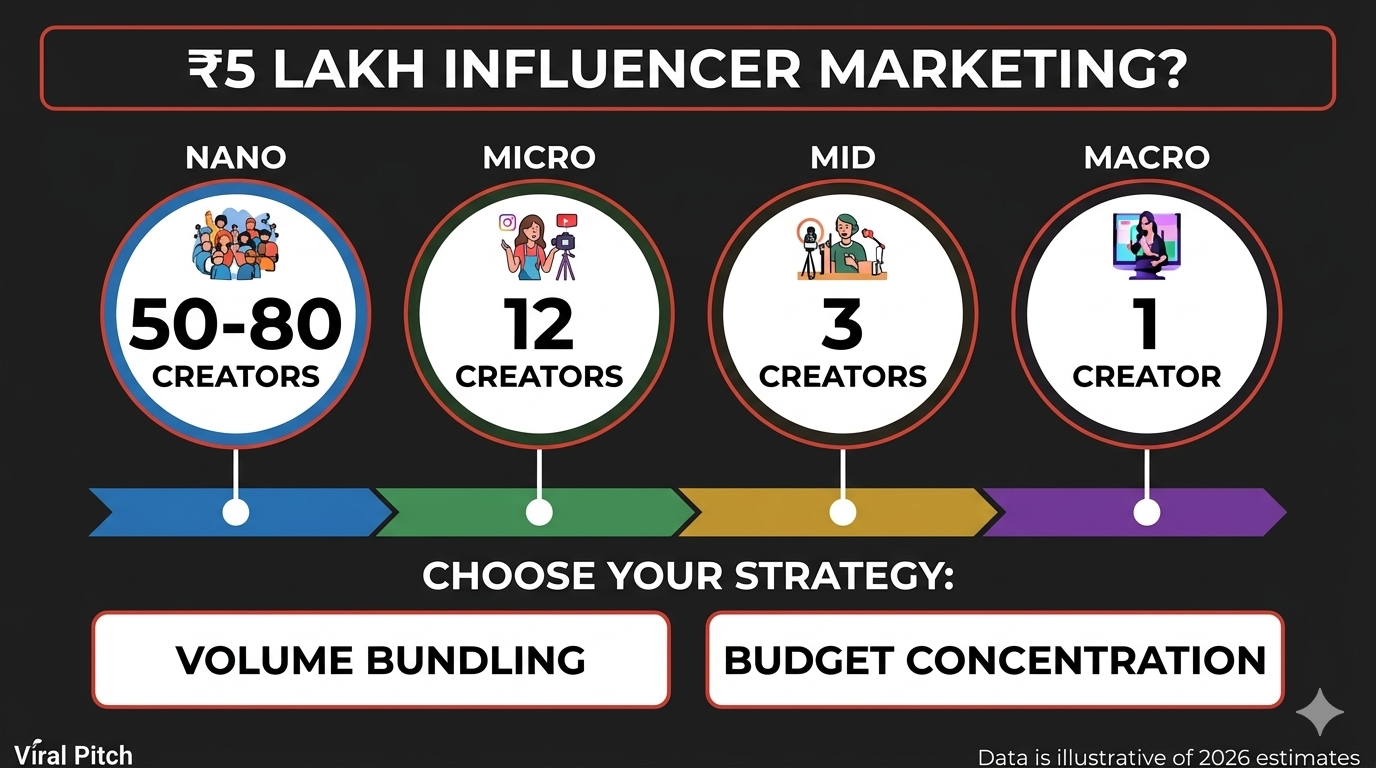
Quick Take: A ₹5 lakh influencer marketing budget in India’s 2026 media landscape can secure either 1 macro creator, ~3 mid-tier creators, ~12 micro creators, or up to 80 nano creators via traditional individual booking models.
-
The Premium Niche: Media efficiency depends heavily on category niches, with finance and tech commanding a 30% to 50% pricing premium over lifestyle.
-
The Automated Shift: Moving from transactional, one-off creator bookings to a volume-negotiated campaign model allows brands to scale distribution to approximately 200 vetted creators for the exact same capital outlay.
The Reality Check: The Problem with Guessing Your Creator Buying Power
When brand managers plan their annual budgets, influencer marketing rates often feel like a moving target. Unlike programmatic Google Ads or Meta campaigns where cost-per-click (CPC) and impression costs are standardized, creator pricing across India remains highly fragmented.
Too often, a growth team sets aside a ₹5 lakh testing budget with a simple goal: get the maximum amount of buzz possible.
The traditional execution follows a predictable sequence. The brand treats creator tiers like a static menu, assuming that more followers equal a linear increase in price. They start reaching out to creators one-off, only to find that two accounts with identical follower counts quote radically different prices. By the time the budget is allocated, the brand has either overpaid for a single macro influencer or buried their internal team under an administrative mountain of paperwork trying to manage dozens of individual invoices.
With inflation hitting media costs across India, a ₹5 lakh allocation cannot afford to be spent on guesswork. To win, brands must understand the structural trade-offs of tier allocation and look at the variables that dictate modern creator pricing.
What ₹5 Lakh Buys: A Tier-by-Tier Breakdown
Look at the 2026 baseline market rates, mapped alongside standard industry Cost Per View (CPV) models:
| Creator Tier | Average Follower Range | Typical Rate Per Reel Post | Industry Average CPV | What a ₹5 Lakh Budget Buys (Individual Booking) |
| Nano | 1,000 – 10,000 | ₹2,000 – ₹10,000 | ₹0.15 – ₹0.20 |
Roughly 50 to 80 creators |
| Micro | 10,000 – 100,000 | ₹10,000 – ₹75,000 | ₹0.25 – ₹0.35 |
Roughly 12 creators |
| Mid-Tier | 100,000 – 500,000 | ₹75,000 – ₹2.5 Lakh | ₹0.40 – ₹0.55 |
Exactly 2 to 3 creators |
| Macro | 500,000 – 1 Million | ₹2.5 Lakh to ₹6 Lakh | ₹0.60 – ₹0.80 |
1 creator (absorbs full budget) |
Operational Insight Note on CPVs: The Cost Per View metrics outlined above represent the definitive baseline benchmarks followed across the Indian digital media industry. Having built, audited, and executed creator programs in this domain for more than 10 years, our team has tracked millions of native data points to isolate these specific average CPV corridors across different tier profiles.
The Budget Trade-off: Concentration vs. Diversification
This matrix highlights the foundational risk strategy every CMO faces. Allocating the entire ₹5 lakh to a single macro creator gives you a high-reach asset but concentrates 100% of your campaign success on a single post. If that video underperforms due to a platform algorithm shift, your capital deployment returns zero efficiency.
Conversely, spreading that same budget across micro or nano tiers builds a diversified portfolio. One underperforming video is easily offset by three others that convert above expectations.
Decoupling the Cost: The Creator Pricing Formula
To take the guesswork out of rate sheet valuations, data leaders rely on structured algorithmic forecasting rather than gut feeling. You can evaluate true fair-market value using the following performance framework:
Estimated Creator Cost = (Average Views × Target Category CPV) + Production Variable Modifier
To apply this formula accurately, define each variable precisely:
-
Estimated Creator Cost: The baseline fair payout rate for a single video deliverable.
-
Average Views: The creator's median video views over their last 30 native posts (excluding viral anomalies).
-
Target Category CPV: The baseline cost per view dictated by the industry category (e.g., lower for general lifestyle, higher for technical finance).
-
Production Variable Modifier: Additional costs for complex overhead, including high-end cameras, professional studio spaces, paid models, or extensive animation and motion design elements.
Why the Same Budget Performs Differently Across Categories
Visible follower counts look like the main pricing signal, but target niches and media formats dictate actual cost cards.
-
The Niche Premium: High-intent, specialized categories like personal finance, B2B technology, and crypto regularly command a 30% to 50% rate premium over lifestyle, fashion, or food creators with identical follower numbers. This is because specialized audiences are highly qualified and deliver a significantly higher conversion value to the brand.
- The Format Tax: Video production assets like Instagram Reels or YouTube Shorts cost two to three times more than static image posts or single Stories. Video requires substantial editing time, hook optimization, and higher engagement watch-through rates, all of which are factored directly into the creator's price.
- The Operational Overhead Leak: While nano creators offer excellent engagement benchmarks (often hovering between 6% and 12%), managing 50 to 80 separate relationships manually incurs heavy internal labor costs. Contract signing, brief alignment, and tracking link distribution create operational leaks that drain a ₹5 lakh budget before the campaign even launches.
Changing the Math: The Scaling Model in Action
The structural ceiling of getting only 50 to 80 nano creators for ₹5 lakh exists because standard agencies handle partnerships as one-off transactions.
Traditional Individual Booking
₹5 Lakh Budget ➔ 50 to 80 Nano Creators (High Administrative Friction and Full Price Rates)
Viral Pitch Scale Model
₹5 Lakh Budget ➔ Bulk Volume Negotiation ➔ ~200 Nano Creators (Automated Operations)
Modern creator infrastructure changes this equation by shifting from transactional sourcing to bulk, automated campaign management. When a platform manages partnerships programmatically at a pan-India scale, handling regional distributions across different states simultaneously, the procurement cost drops significantly.
Demystifying the Math: How to Reduce Costs Without Sacrificing Creator Quality
Dropping the effective cost per creator to a baseline of ₹2,500 without sacrificing output quality sounds impossible, but it is achieved through extreme operational automation. The scaling model eliminates the manual, high-friction steps that inflate traditional agency bills:
-
AI-Powered Fraud Filtering: Instead of manual vetting, algorithmic screening instantaneously cross-references candidate lists against historical engagement benchmarks, fake follower thresholds, and audience location metrics. This allows the system to extract the top tier of authentic nano-voices at scale.
-
Boilerplate Legal Infrastructure: Traditional individual contract negotiations are entirely replaced by platform-native digital terms. Creators accept automated, legally binding compliance frameworks with a single click, totally erasing manual legal overhead costs.
-
Standardized Programmatic Briefings: Creative directions, tracking loops, and disclosure mandates are distributed through unified platform dashboards. One single campaign update communicates with all 200 creators simultaneously, allowing execution teams to maintain brand consistency without human hours being spent on individual chat threads or manual emails.
Strategic Capital Efficiency Comparison
-
The Individual Approach: Booking nano creators one by one results in an average cost of ₹6,000 to ₹10,000 per asset, capping your campaign footprint.
-
The Volume System: Running the same campaign through an automated infrastructure model allows for bulk-negotiated creator bundles. This drops the effective average cost per creator down to roughly ₹2,500, allowing the exact same ₹5 lakh budget to activate up to 200 creators.
This model shifts your focus away from individual negotiations, giving your brand widespread, regional coverage without expanding your internal team's workload.
The Expert Voice
"Brands obsess over which tier to pick, but the bigger budget leak is almost always audience quality, not tier choice. At Viral Pitch, we run campaigns across industries starting with the biggest spenders like HUL to P&G. We once ran a campaign with a ₹5 lakh budget wherein our in-house platform properly screened and coordinated with 200 creators, and that infrastructure consistently outperforms the same ₹5 lakh spent on a single macro creator with an inflated following."
Action Plan: Maximizing a ₹5 Lakh Budget
If you are currently executing or auditing a mid-tier influencer marketing campaign, follow this optimization checklist to secure maximum media value:
1.Isolate Your Core KPI First:Prerequisite.
Define whether your campaign is optimizing for upper-funnel brand awareness or lower-funnel conversions before choosing your creator tier mix.
2.Run Pre-Outreach Fraud Audits:Risk Mitigation.
Ensure your agency or platform runs comprehensive audience authenticity checks on your shortlist before a single rupee is committed.
3.Avoid Single-Asset Bets:Portfolio Allocation.
Unless immediate mass awareness is your solitary metric, default to a diversified spread of micro and mid-tier partners to hedge performance risk.
4.Secure Multi-Asset Bundles:Negotiation Strategy.
Never pay flat per-post rates. Negotiate packages (such as two Reels plus three sequential Stories) upfront. Bulk asset bundling typically yields a 20% to 35% discount per deliverable.
5.Audit the Internal Management Cost:Operational Efficiency.
Calculate the human hours required to execute your campaign. If your team is spending more time managing logistics than analyzing performance data, transition to an automated platform model.
Sources & Reference Data:
-
Influencer Marketing Cost in India: Complete 2026 Pricing Guide — Jigsawkraft
-
Influencer Marketing Pricing India 2026: Full Rate Card — upGrowth
-
Influencer Pricing Guide: How Much Do Influencers Cost? — Modash